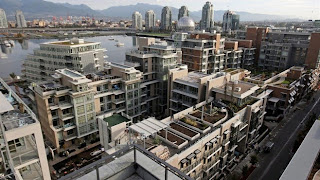
I am captivated by the idea of the city, and the idealized ways that people can live as a part of it. I’m certain this is one of the reasons that I chose the profession of Architecture, which is itself, an ongoing utopian study of the way people use the space they inhabit. Various other arts are inherently capable of acting as substitute for architecture when the later isn’t a fitting medium. Sculpture obviously, all manners of two-dimensional art, photography, graphic design, etc. have a spatial component that has a direct link to the architectural quality of inhabiting space. It’s rare, at least in my experience, that literature can fill that spatial void in a way that creates an equally exciting experience.

The City & The City accomplishes the interesting feat of using language to create a spatial city that simply couldn’t exist outside of it’s pages. Unlike most fantasy or science-fiction novels, where the setting is simply somewhere that we haven’t yet discovered or explored, here China Mieville has written a standard detective murder mystery that occurs in an uncommon setting; two separate cities inhabiting the same space. If two objects cannot occupy the same space at the same time, then the cities Beszel and Ul Qoma can only exist in the pages of this novel. The descriptions of the two cities, their limitations and boundaries are continually refined throughout the novel, and truthfully, there are several ways to interpret how this place can exist. The novel itself however is a wonderful spatial exploration using only its words to define boundaries and is itself a study of how those boundaries are explored & broken
First I’d like to address the literary symbolism that exists in the novel simply as an acknowledgment to further explore the spatial experience unimpeded. As you progress through the story, you’re constantly confronted with the question of whether these two cities are actually independent civic entities or whether social and legal restrictions simply limit the ability for the citizens to actually “inhabit” the entirety of the city surrounding them. No definitive answer is ever given, but there are numerous clues that hint at both possibilities. The citizens of each city are prohibited from looking at, interacting with or acknowledging the existence of the other city that they are at least partially inhabiting. Perhaps this setting is a metaphorical attempt to describe the physical realization of current urban problems ranging from class/castes, to religious segregation, or gentrification & reurbanization, or even ghettoization. Are we trained from youth to “unsee” someone sleeping in an alley entrance? Have we not yet fully realized why the majority of our cities are still ethnically divided? You can even go so far as to ask how can Israel & Palestine both occupy the same sliver of land? These are current social issues that might be influences behind the “parable” of The City & The City. While interesting from a literary standpoint, I’m more interested in the cities as independent habitable entities.
 |
| Copyright Mayang |
Mieville spends a lot of effort in exploring the two cities, and describing how the citizens of each perceive their own city and the other that is intertwined with it. He uses words like “crosshatch”, and “topolganger” to help the reader visualize how this place can actually exist. While some areas of the environment are strictly within Beszel or completely within Ul Qoma, a crosshatched area is a portion of the environment where both cities exist in the same place. A “topolganger” is a topographic doppelganger, inventively describing the two building that occupy the same space, independent of each-other, one in each city. What I continued to be amazed by was how visual Mieville was able to make these cities. I love the idea of the crosshatch, and began marking its use in my copy of the novel. The layers that can be explored in the environment with the crosshatch as a visual representation begin to feed one another. There are two sets of perpendicular lines in a crosshatch, each representing one city. However, this graphic method leaves small patches of “nothing” landlocked between them; which then opens the plotline to a potential third in-situ city, Orciny, which might be all the intertwined spaces that are neither Beszel or Ul Qoma. I love that exploration, and also how Mieville studies the potential historical events that led to the creation of this unique environment.
 |
| Borrowed from sfcityguides.org |
“It is a heavily crosshatched street-clutch by clutch of architecture broken by alterity, even in a few spots house by house. The local buildings are taller by a floor or three than the others, so Besz juts up semiregularly and the roofscape is almost a machicolation. (p. 24)
“I walked by the brick arches: at the top, where the lines were, they were elsewhere, but not all of them were foreign at their bases. The ones I could see contained little shops and squats decorated in art graffiti. In Beszel it was a quiet area, but the streets were crowded with those elsewhere. I unsaw them, but it took time to pick past them all.” (p.25)
“In Beszel it is an unremarkable shopping street in the Old Town, but it is crosshatched, somewhat in Ul Qoma’s weight, the majority of the buildings in our neighbour, and in Ul Qoma its topolganger is the historic, famous Ul Maidin Avenue, into which Cupola Hall vents.”
(p. 132)
“I looked at what Dhatt showed me. Unseeing of course, but I could not fail to be aware of all the familiar places I passed grosstopically, the streets at home I regularly walked, now a whole city away, particular cafes I frequented that we passed, but in another country.” (p. 135)
Jonathon Lethem is another favorite author of mine, who uses the city as a character in his writing, generally New York. Mieville takes that characterization a step further in this work, and makes the city THE character. There is a plot that is advanced by individuals who are brought together by the murder of a young woman. This mystery however is only a vehicle for feeding the reader more and more of the spatially impossible descriptions that are the most successful part of this novel. I couldn’t help but imagine that Mieville got his hands on an “Invisible City” that was edited out of Calvino’s book and chose to write a novel using it as his setting. I definitely want to read through The City & The City again, but I wish I could go back and read it for the first time as well. Being slowly made aware of what this place actually is, was a wonderful experience.